
STAT-001
313
internet shutdowns in 2025, the latest full year counted, app blocks and local cuts included
Access Now #KeepItOn 2025 report, p. 5 and 6
Count by a rights group Original source ↗
The 17 November 2026 blackout rumour, and what could really bring the internet down.
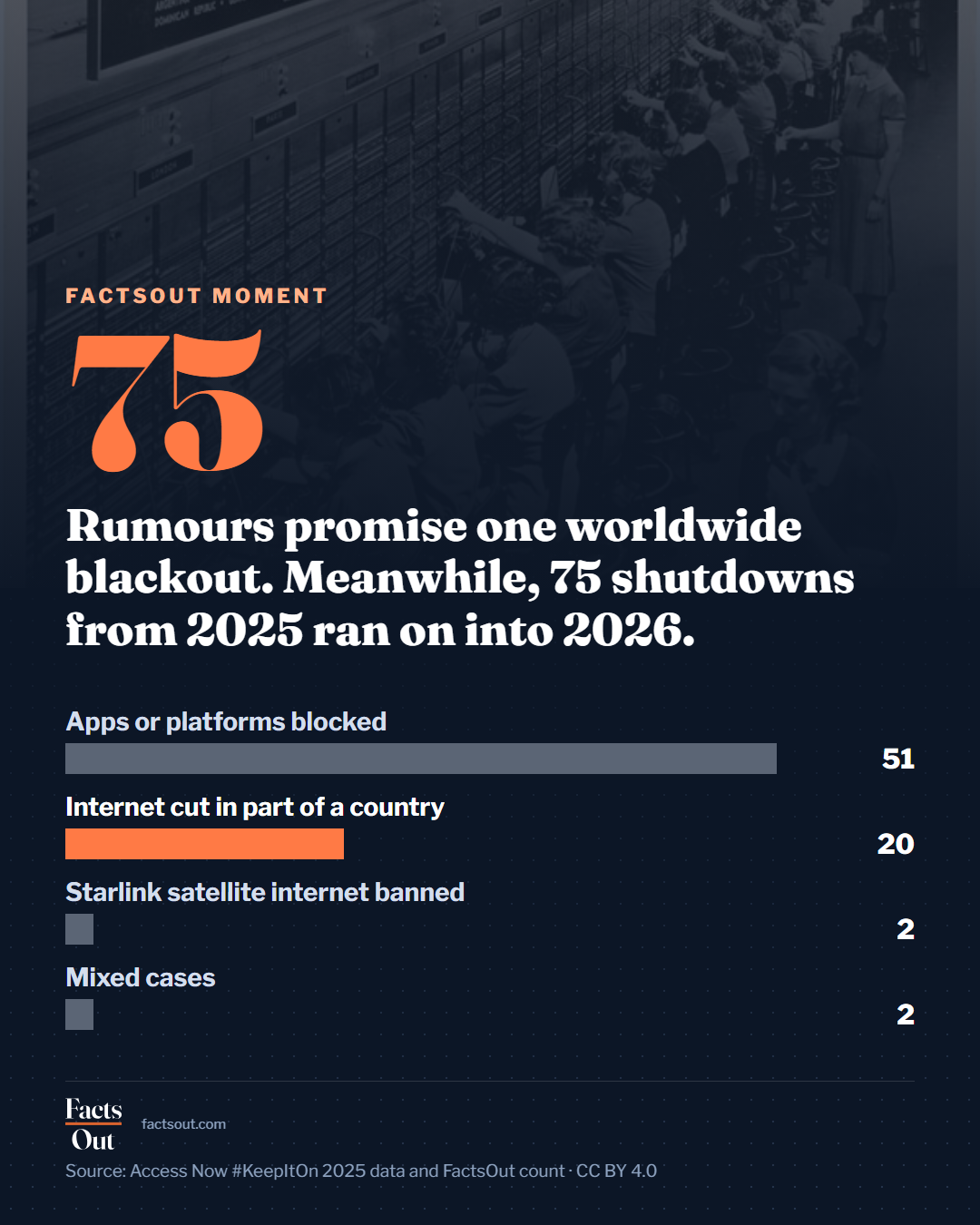
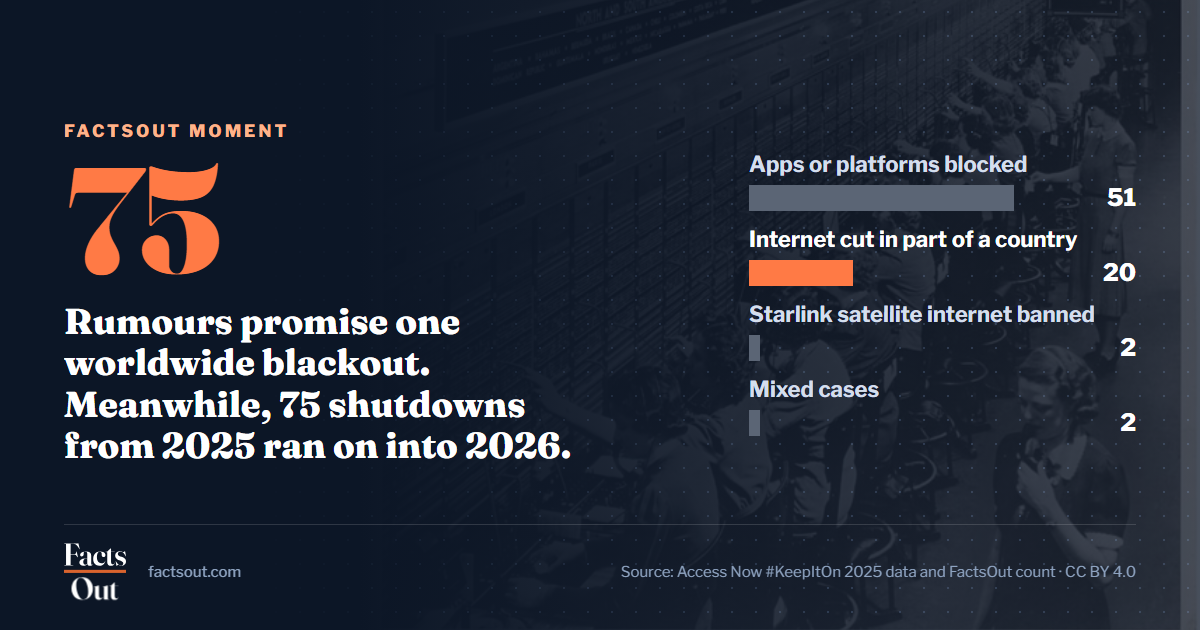
FactsOut MomentRumours promise one worldwide blackout. Meanwhile, 75 shutdowns from 2025 ran on into 2026 (Access Now).Our count from Access Now's public data for 2025: 74 shutdowns marked "Ongoing", plus a cut in eight Iranian cities that ended on 8 January 2026. Cuts in part of a country: 12 in Myanmar, 2 in Nigeria, and one each in Iran, Tigray (Ethiopia), Panjgur (Pakistan), Gaza, Annobón (Equatorial Guinea) and one operator in Kurdistan (Iraq). Starlink bans: Iran and Houthi areas of Yemen. Mixed cases: Amhara (Ethiopia) and Russia's slowdown of Twitter. Sources: Access NowAccess Now #KeepItOn 2025 data and FactsOut count
On the viral claim that the whole internet would go dark on 17 November 2026
False.
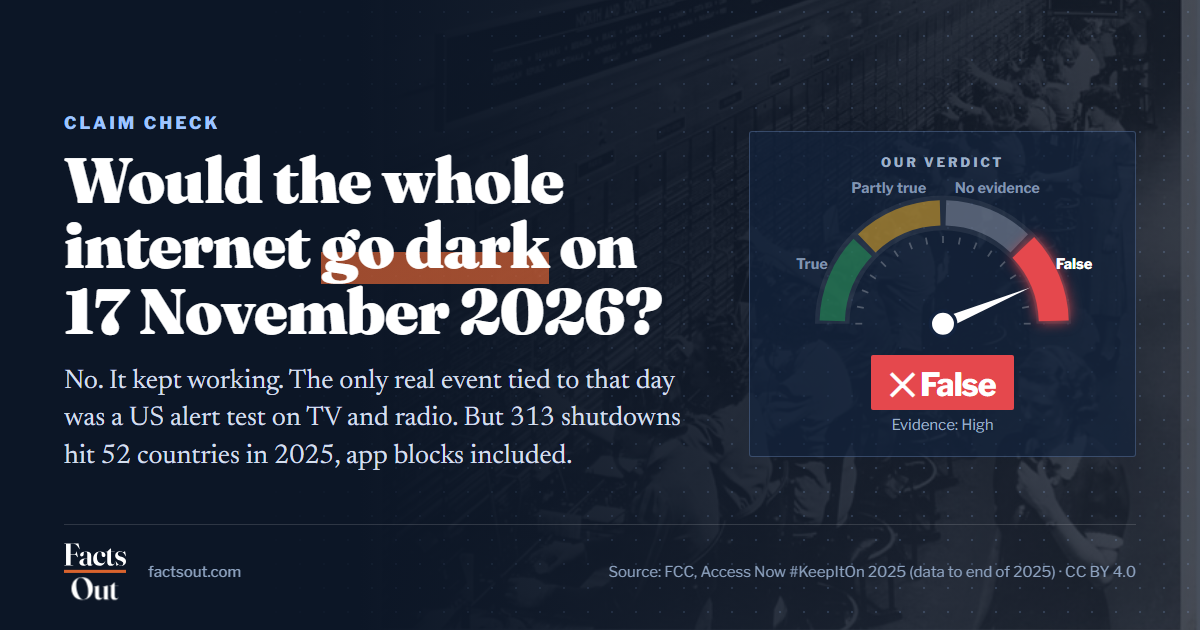
The internet kept working around the world on 17 November 2026. The only official event tied to that day was a US alert test on TV and radio. FEMA said it was completed successfully. Separately, we found no report of bank balances being wiped. No one can switch off the whole internet, ICANN says. But countries and regions do go dark: Access Now counted at least 313 shutdowns in 2025, app blocks included.
In short. No one switch can do it. The 17 November 2026 rumour was false, and the internet kept working. But countries and regions go dark often, and 75 shutdowns from 2025 ran on into 2026.
At least 313, in 52 countries. That is the most since it started counting in 2016. App blocks and local cuts count too. Access Now
Each figure with its source, period and what it measures.
313
Access Now #KeepItOn 2025 report, p. 5 and 6
75
Access Now #KeepItOn 2025 report, p. 5
88days
Cloudflare Radar, Q2 2026 summary
125
Access Now #KeepItOn 2025 report, p. 7
150–200
International Cable Protection Committee, 2026
2,046copies
root-servers.org, 17 November 2026
Each rumour took a real, routine event and added a worldwide blackout and a date.
Infected computers were to lose the internet when the FBI switched off temporary servers. The servers went off without creating major problems, GCN reported.
Based on a Russia Today report, a news agency said a global internet shutdown was likely while ICANN changed a key that secures internet addresses. ICANN said the change went through with minimal disruption.
A TikTok video said the internet would shut down on 11 October 2023. Lead Stories rated it baseless: the TV clip it used was from 2019.
Posts said NASA warned of a months-long internet apocalypse. NASA had issued no such warning, Gulf News found. On its peak day the storm cost Starlink users less than a minute on average, SpaceX said.
A user in Brazil posted on X that the internet would go down worldwide for 90 days from 17 November and that bank balances would be wiped. The Russian site RIAMO reported over 4 million views.
Each one checked against the counts, the official notices and the research.
The whole internet would go down on 17 November 2026
It kept working around the world. The Internet Society listed no new shutdown on 17 or 18 November, and we found no news report of a worldwide outage. The only official event tied to that date was a US alert test on radio and TV.
✕FalseBank balances would be wiped on the same day
We found no report from any bank, regulator, news site or fact-checker of balances being wiped on 17 November 2026. We searched news in English, Russian and Portuguese. The posts offered no proof beyond an unnamed "dark web" source.
✕FalseOne switch can turn off the whole internet
"No one actor has the ability to control it or shut it down," ICANN wrote in 2022. A country can cut itself off, but not the world.
✕FalseSolar storms have taken the internet down before
The strongest storm in 20 years, in May 2024, caused no major internet outage we could find. The biggest storm on record, in 1859, came before the internet.
✕FalseInternet shutdowns are rare
Access Now counted at least 313 in 2025, in 52 countries. Every day of the year had at least one.
✕FalseA US alert test on TV and radio. FEMA said the test went out at about 2:20 pm Eastern time, which is 19:20 UTC, and was completed successfully.
FEMA said it and the FCC "successfully" completed the test. It went out on radio, TV, cable and satellite in the United States. The two agencies will now review the results. Their formal notices said nothing about switching off the internet, about banks or about any other country.
Phones were not part of this test. It was for the broadcast alert system only, with no alert to mobile phones, Radio World reported.
The internet kept working around the world. The Internet Society's tracker listed no new shutdown on 17 or 18 November. Cloudflare, a large internet company, listed seven problems that day. Each hit only some of its services or places, and all were fixed by early 18 November. None was marked as global. We found no news report of a worldwide outage.
We checked the bank claim on its own. We found no report from any bank, regulator, news site or fact-checker of balances being wiped on 17 November 2026. The day before, a software bug at JPMorgan Chase delayed online banking for some US customers. Chase said it was not a cyber attack, AP reported. No report said money was wiped.
No. ICANN coordinates the internet's address system. It wrote in 2022: "No one actor has the ability to control it or shut it down."
The internet's main address book helps every computer find websites. It runs as 2,046 copies kept by 12 separate groups. Attacks on it in 2002, 2007 and 2015 did not stop it. In 2015 its keepers knew of no reports of errors that users could see.
A country can switch off its own internet, though. Iran did it for 88 days from 28 February 2026, during military strikes on the country. It cut off people in Iran, not the rest of the world. A national switch mainly hits people inside that country.
Three different things can go dark, and they are easy to mix up. One service, one country or region, or the links between continents.
One service: when a big company fails, every site that uses it fails too. Cloudflare went down for about three hours in November 2025, and Facebook went offline in October 2021. The rest of the internet kept working.
One country or region: a government order, a power cut, a storm or a broken cable can cut a whole area off. In January 2022 a volcano broke Tonga's undersea cable to the world. The country was mostly offline for 38 days. In March 2024, faults on four cables hit 13 countries in Africa.
Links between continents: undersea cables carry most international traffic. The International Cable Protection Committee counts 150 to 200 faults a year, mostly from fishing and ship anchors. The network routes around most of them. Repair ships now take longer to start work. Between 2012 and 2024, the average wait rose from under 20 days to over 50, a UN and industry report found.
No storm has done it so far. Only a very rare one could break many links between continents, and that is a scientific model, not a forecast.
What has happened: the strongest storm in 20 years, in May 2024, caused no major internet outage we could find. On its peak day Starlink users lost less than a minute on average, SpaceX said. The biggest storm on record, in 1859, came before the internet.
What one model says: the weak point in sea cables is not the glass fibre. It is the repeaters, which boost the signal every 50 to 150 km and run on power. A storm as big as the one in 1859 could damage them, computer scientist Sangeetha Abdu Jyothi wrote in 2021. In her model, many long cables between continents fail. The US is among the places most at risk of losing its links to Europe.
How likely is it? Studies she cites put the chance of such a storm at 1.6% to 12% per decade. That is the chance of the storm, not of an internet failure. Her failure rates are assumptions, because the cables have never been tested in such a storm. NOAA, the US weather and ocean agency, says extreme storms can upset power grids, satellites and navigation.
More than people think. Broadcast radio and TV alerts can reach people without the internet.
In the US, the national alert reaches the first radio stations over a secure phone line. Those stations have backup generators, the FCC says. A GPS receiver works out its position from satellite signals alone.
At least 313 times in 2025, in 52 countries, the most since Access Now started counting in 2016. Every day of the year had at least one.
Access Now counts any deliberate cut of the internet or an app that lasts over an hour. So the 313 are not all whole countries going dark. They include 94 app blocks, regional mobile cuts and cuts by armed groups. Armed conflict was the most common setting, with 125. Protests came next, with 64.
Myanmar had the most, at least 95, then India with 65, Pakistan with 20, Russia with 19 and Iran with 11. The US is on the list for one app block. TikTok and other ByteDance apps went offline for 14 hours in January 2025.
Because each tracker counts different things over different periods. Do not compare their numbers directly.
Access Now includes app blocks and small local cuts, and counts a long block again each year. Top10VPN counted 212 major government shutdowns in 2025. Surfshark counted 81 new restrictions. Cloudflare sees all causes in its own traffic. From July to September 2026 it saw 49 disruptions. Governments ordered 19 of them, and 18 of those were exam shutdowns in Iraq. The Internet Society counted 69 shutdowns in 8 countries since November 2025.
Surfshark sells VPN apps and Top10VPN reviews them. A VPN, an app that sends your traffic through another country, can get around some blocks. So read their numbers with that in mind.
Every chart is drawn from the downloadable data.
Shutdowns in 2025
Counted where people were cut off, app blocks included. Seven of these places were also cut off from outside, for example by bombed cables or cyber attacks. The regions are our own grouping: Access Now gives no totals by region. Sources: Access Now
Shutdowns counted by Access Now each year. These are the revised numbers in its 2025 report, which add shutdowns found late. 2025 is the latest full year.
Sources: Access Now
| Who counted | Period | Count | What they count |
|---|---|---|---|
| Access Now (rights group) | 2025 | at least 313, in 52 countries | Every deliberate cut over one hour, including app blocks, slowdowns and cuts by foreign armies |
| Top10VPN (VPN reviews) | 2025 | 212, in 28 countries | Major cuts imposed by governments: blackouts, social media blocks and severe slowdowns |
| Surfshark (VPN company) | 2025 | 81 new restrictions, in 21 countries | New government restrictions on the internet or apps |
| Cloudflare (network company) | July to September 2026 | 49 disruptions, 19 ordered by governments | Disruptions seen in its own traffic, from all causes |
| Internet Society Pulse (non-profit) | November 2025 to 17 November 2026 | 69 shutdowns, in 8 countries; 10 ongoing on 17 November | Total or partial intentional shutdowns |
Sources: Access NowTop10VPNSurfsharkCloudflareInternet Society Pulse
No one has a full count for 2026 yet. Access Now publishes its yearly count in spring: the 2025 report came out in March 2026. The Internet Society's tracker counts from November 2025, so its numbers cannot be compared with Access Now's. Undersea cables have never been tested in a solar superstorm, so the risk from one is a model, not a measurement. Access Now publishes no totals by region, so the regions on this page are our own grouping. Some shutdowns may go unreported. We found no shutdown in Australia or New Zealand in any count we checked.
Three cards, each made from this page's data. Settle the argument in the group chat.
Every number on the cards comes from this page's data. Please credit the source and link here so people can check it.
Need a figure for your own country or a different year? The data is downloadable below, and questions are welcome.
Wording you can copy. Each line says where the number comes from, so your readers can check it.
No one can switch off the whole internet, but countries and regions go dark often: Access Now counted at least 313 shutdowns in 52 countries in 2025, app blocks included.
FactsOut wording, based on ICANN and Access Now's #KeepItOn report 2025
75 internet shutdowns from 2025 ran on into 2026, in 33 countries. Most blocked apps or platforms; 20 cut the internet in parts of a country.
FactsOut wording, based on Access Now's #KeepItOn report 2025 and its public data
Niskasaari, L. (2026). Could the entire internet really go dark? FactsOut. Retrieved 17 Nov 2026.
Editor · Questions about the data and corrections are welcome.
Reuse and licensing: CC BY 4.0: free to reuse numbers, tables and the card with credit. If you publish online, please link to this page. Access Now's figures are facts, and its original website material is CC BY 4.0, so credit Access Now #KeepItOn as well. Figures from other organisations keep their own credit.
Where the figures come from and what they can and cannot tell us.
Check the viral claim that the whole internet would go dark on 17 November 2026, and answer the lasting question: could the entire internet really go dark?
The official plans for 17 November 2026; earlier blackout rumours; what keeps the internet running (address servers, undersea cables) and what has broken it (outages, cable cuts, solar storms); and every internet shutdown counted worldwide from 2016 to 2025, plus 2026 events.
Official notices, technical bodies (ICANN, root server operators, the cable protection committee, ITU, NOAA) and companies' own outage reports first. For shutdowns, Access Now's count, because it covers every continent and every kind of cut, and four other counts to compare.
We read every figure from the original report, notice, data or company post on 17 Nov 2026. The yearly numbers are the revised ones in Access Now's 2025 report. The split of the 75 shutdowns that ran on into 2026 is our own count of Access Now's public data.
Access Now: 52 countries on six continents in 2025. 2026 events: Cloudflare's quarterly summaries and the Internet Society's tracker. Rumour checks: Russia, Kazakhstan, Hong Kong and earlier fact-checks.
Our grouping of the 52 countries into regions, and our count of the 75 shutdowns that ran on into 2026 by type. Access Now's country numbers add up to 314, one more than its total of 313. We show both as given.
Counts differ because each tracker counts different things and periods. Some shutdowns may go unreported. The solar storm risk comes from one model with assumed failure rates. The ITU report, the solar storm paper and the Internet Society tracker do not allow commercial reuse, so we only cite single facts from them with credit and copy no text or charts.
No funding, no ads and no affiliate links on this page. Drafted with AI help. Before publishing, every number is checked against its original source.
Six separate checks on 17 Nov 2026 compared every number with its original source: two on the first version, two on the rebuilt page and two on the final changes. One more check on 18 Nov 2026 compared each changed sentence with its source. Not reviewed by an outside expert.
Rising repression meets global resistance: Internet shutdowns in 2025 (annual report, by Zach Rosson and Felicia Anthonio)
Yearly totals p. 6, country map p. 4, 75 shutdowns carried into 2026 p. 5, reasons p. 7, app blocks p. 21, United States p. 24, Iran p. 30. Access Now material is CC BY 4.0 (its media usage page).
Open original source#KeepItOn STOP data 2016–2025 (public spreadsheet)
Our count of the 75 shutdowns that ran on into 2026 (report p. 5): 74 rows marked "Ongoing" in the 2025 tab, plus a cut in eight Iranian cities from 29 December 2025 to 8 January 2026, the only 2025 row that ended in 2026 (our reading). 51 block apps or platforms; 20 cut the internet in part of a country (12 in Myanmar); 2 ban Starlink satellite internet (Iran from 30 June 2025, Houthi areas of Yemen), which Access Now codes as full network; 2 combine app blocks with a cut or slowdown. 57 began before 2025, the oldest in 2009. The 2025 tab also has 75 rows with status "Unknown" and no end date, mostly short local cuts in Myanmar.
Open original sourceShutdown Tracker Optimization Project (STOP): how shutdowns are defined and counted
Definition and the one-hour rule.
Open original source#KeepItOn report on internet shutdowns in 2024
First count for 2024: 296 in 54 countries, later revised to 304 in 55.
Open original sourceInternet shutdowns tracker
Read 17 Nov 2026: 10 shutdowns ongoing; 69 total or partial shutdowns in 8 countries since November 2025. All rights reserved: we cite these facts with credit only.
Open original sourceQ1 2026 Internet disruption summary
Iran shutdowns from 8 January and 28 February; drone strikes on AWS sites in the UAE and Bahrain.
Open original sourceQ2 2026 Internet disruption summary
End of Iran's 88-day shutdown on 26 May; the .de domain failure on 5 May.
Open original sourceQ3 2026 Internet disruption summary
49 disruptions: 19 ordered by governments, 14 power outages, 5 natural disasters.
Open original sourceLetter from Göran Marby to Mykhailo Fedorov, 2 March 2022
"No one actor has the ability to control it or shut it down."
Open original sourceroot-servers.org
2,046 operational instances run by 12 independent operators.
Open original sourceFactsheet: Root server attack on 6 February 2007
2007: "very limited impact on actual Internet users". 2002: nine of 13 servers swamped, "The Internet continued to run".
Open original sourceEvents of 2015-11-30
"no known reports of end-user visible error conditions".
Open original sourceMedia enquiries: facts about submarine cables
About 500 cable systems; 150–200 faults a year, 70–80% from accidental human activity such as fishing.
Open original sourceReport of the Working Groups 2026
Average wait before a repair starts rose from under 20 days to over 50 days (2012–2024, p. 12). Licence CC BY-NC-SA 3.0 IGO: we cite facts with credit only.
Open original sourceTonga back online after 38 days of no internet due to volcanic eruption
The eruption broke an 80 km stretch of Tonga's only international cable.
Open original sourceUndersea cable failures cause Internet disruptions across Africa
13 African countries affected by failures on four cables.
Open original sourceSolar Superstorms: Planning for an Internet Apocalypse
Repeaters in long sea cables are the weak point, not the fibre (p. 692). Cited estimates 1.6% to 12% per decade (p. 694). The model's failure rates are assumed (p. 698); the cables were never stress-tested (p. 695). Licence CC BY-NC-SA 4.0: we cite facts with credit only.
Open original sourceNASA, NOAA: Sun reaches maximum phase in 11-year solar cycle
May 2024: "the strongest geomagnetic storm at Earth in two decades".
Open original sourceSpaceX, Iridium boast of resilience during geomagnetic storm
SpaceX: the average Starlink user saw less than one minute of disruption.
Open original sourceNOAA space weather scales
G5 (extreme): power grid problems, satellite and navigation problems, HF radio out for one to two days. The scale does not mention the internet or sea cables.
Open original sourceReport: October 4, 2023 Nationwide Emergency Alert Test
The national alert reaches the first radio stations over a secure phone line; those stations have backup generators (p. 29).
Open original sourceHow does GPS work?
GPS receivers only receive satellite signals and work out their position from them.
Open original sourcePublic Notice DA 26-989: nationwide test of the Emergency Alert System on November 17, 2026
2:20 pm Eastern time, backup date 3 December 2026.
Open original sourceWhat to expect during the November 17 nationwide Emergency Alert System test
Radio, TV, cable and satellite. Does not mention phones, banks or the internet.
Open original sourceFEMA Outlines Expectations for National EAS Test
"The November test is EAS only, meaning it has no Wireless Emergency Alert component."
Open original sourceDigital apocalypse: is it true the internet will be switched off worldwide for 90 days on November 17? (in Russian)
Traces the rumour to a post on X by a user in Brazil on 1 November.
Open original sourceWill the internet be switched off on November 17? (in Russian)
The emergency ministry issued no warning; Kazakhtelecom had no confirmed information about a threat.
Open original sourceViral posts claim 17th November will wipe bank balances and trigger a three-month global internet blackout
No authority or bank has confirmed any threat.
Open original sourceFEMA and FCC Successfully Complete Nationwide Emergency Alert System Test
Release HQ-26-178. The test message went out at about 2:20 pm ET on radio, TV, cable, satellite and wireline video. FEMA and the FCC will review the results. No phone alerts.
Open original sourceInternet shutdowns tracker (read 18 November 2026)
Read 18 Nov 2026: no shutdown began on 17 or 18 November. The newest, a block of Telegram in Jordan, began on 16 November. All rights reserved: we cite these facts with credit only.
Open original sourceCloudflare Status: incident history
Read 18 Nov 2026: seven incidents began on 17 November (UTC), each with some of its services or places. All were resolved by 03:23 UTC on 18 November. None marked as global.
Open original sourceA technical issue at JPMorgan Chase triggers online banking delays across major US banks
Chase blamed "a software bug in an on-premise hardware system" and said it "is not cyber-related". No mention of balances wiped.
Open original sourceDNSChanger servers shut down, Internet survives
The FBI servers went off "without creating major problems".
Open original sourceFirst root KSK rollover successfully completed
"completed with minimal disruption of the global Internet".
Open original sourceGlobal internet shutdown likely over next 48 hrs
Based on a Russia Today report about the ICANN key change.
Open original sourceFact check: internet does not shut down globally in October 2023 (in Arabic)
Rated baseless; the clip it used was from 2019.
Open original source"Internet apocalypse": solar storm misinformation spreads
NASA had not warned of any "internet apocalypse".
Open original sourceCloudflare outage on November 18, 2025
Not a cyber attack; core traffic largely normal by 14:30 UTC.
Open original sourceMore details about the October 4 outage
"an error of our own making".
Open original sourceThe cost of internet shutdowns in 2025 (by Simon Migliano)
Major government-imposed outages only.
Open original sourceInternet shutdowns in 2025
New government restrictions; 130 including ones still running.
Open original sourceNew claim page.
We checked FEMA, the FCC, the Internet Society, Cloudflare and news in English, Russian and Portuguese on 18 Nov 2026.
CC BY 4.0: free to reuse numbers, tables and the card with credit. If you publish online, please link to this page. Access Now's figures are facts, and its original website material is CC BY 4.0, so credit Access Now #KeepItOn as well. Figures from other organisations keep their own credit.
Niskasaari, L. (2026). Could the entire internet really go dark? FactsOut. Retrieved 17 Nov 2026.