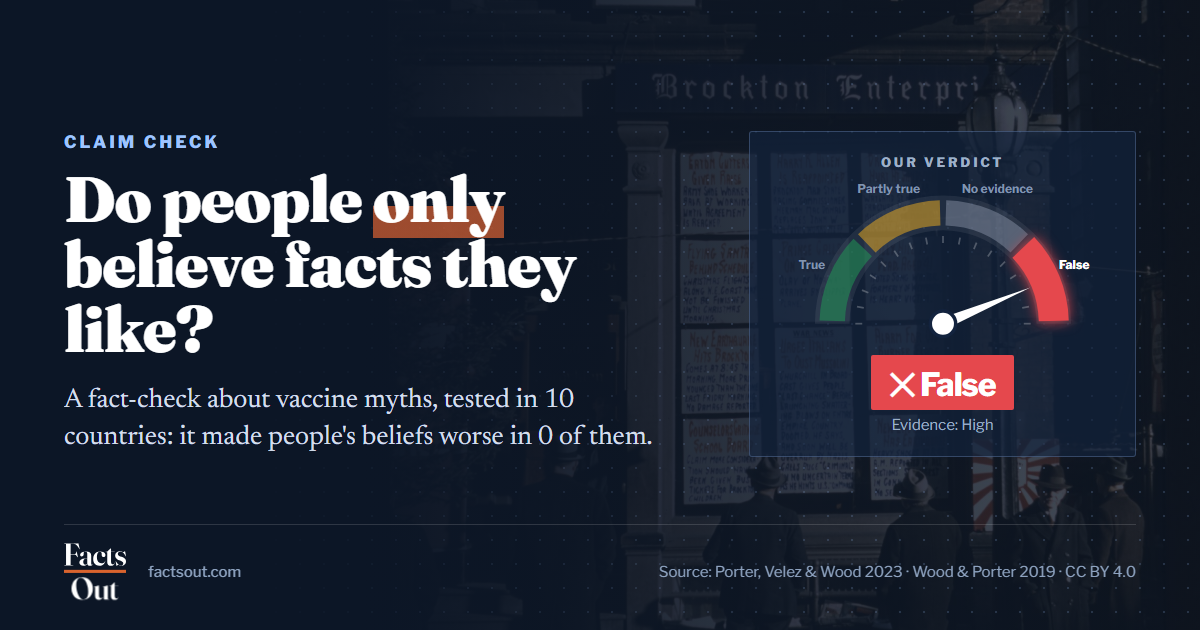
Many people say facts do not change anyone's mind if they do not like them. We read studies from 23 countries on six continents, about vaccines, health, climate and politics.
Our verdictEvidence: High · Checked 12 Nov 2026 · History
✕False.
A test in 10 countries, from Brazil to Nigeria, checked a fact-check about vaccine myths. It made beliefs more accurate in 8 countries and worse in none. Most other studies on politics, health and climate found the same. But in Brazil, fact-checks did not work during the 2018 election or on Zika myths.
In short. No. In 10 countries, a fact-check about vaccine myths made beliefs more accurate in 8 and worse in none. People do prefer information that agrees with them, and a fact-check often gets weaker over time.
Before we show you the data
Try it yourself first
None. In 8 of the 10 countries, beliefs became clearly more accurate. In India and Indonesia, the change was too small to be sure. SRC-PVW2023
Key figures
The numbers that matter
Each figure with its source, period and what it measures.
Every value has a source
STAT-001To verify
0 of 10countries
countries where a fact-check about vaccine myths made people's beliefs worse
10,600 people · Brazil, France, Germany, India, Indonesia, Mexico, Nigeria, Peru, South Africa, US · 2021
1Correcting people makes them believe the false claim even more
No. Not in any of 10 countries tested on vaccine myths. Not on any of 52 political topics tested in the US either.
✕False
2People prefer information that agrees with them
Yes. On average across 91 studies, people chose agreeing information more often. In five countries, people picked news that agreed with them about 55% of the time.
✓True
3Fact-checks only work in rich Western countries
No. They worked in Nigeria, South Africa, Brazil, Mexico and Peru. But in Brazil's 2018 election, fact-checks did not reduce belief in fake stories.
✕False
4If people accept a fact, they change what they do
Not always. After a flu vaccine fact-check, the most worried people believed the myth less but were less willing to get vaccinated.
✕False
5When asked, most people want news that agrees with them
No. In the Reuters Institute's 2026 survey, 45% preferred news from sources with no particular point of view. 22% preferred sources that share their views.
✕False
Short answers
Questions people also ask
Does this hold outside the US?
Mostly yes. Ethan Porter, Yamil Velez and Thomas Wood tested vaccine fact-checks with 10,600 people in 10 countries. Beliefs became clearly more accurate in 8 countries and worse in none.
Another test ran in Argentina, Nigeria, South Africa and the UK. There, fact-checks lowered belief in false claims by 0.59 points on a 5-point scale. In Australia, voters on the left and the right both believed false statements by politicians less after a fact-check.
But it does not work everywhere. In Brazil's 2018 election, fact-checks did not reduce belief in six fake stories, even among people with no party. In Brazil, a fact-check about Zika did not reduce the myths and made some people doubt true facts too.
Does it work for health and science, not just politics?
Yes, and often more easily. A review of 65 studies found that correcting health myths works better than correcting political or marketing claims. The same review found that real false claims are harder to correct than ones made up for a test.
In the UK, a sheet of vaccine myths and facts lowered belief in the autism myth right after reading. On average, it did not make people believe the myth more. A week later, the difference was too small to be sure.
A smaller 2017 study of 120 students in Scotland and Italy found something different. Belief in the autism myth went back up in the week after reading. The study does not say if it ended higher than before reading. The larger UK study tried to repeat this and could not.
In the US, people learned that 97% of climate scientists agree. Their view of how much scientists agree changed most among conservatives and doubters.
If people accept a fact, do they change what they do?
Not always. In the US, a fact-check said the flu vaccine cannot give you the flu. Fewer people believed the myth. But look at the most worried people. The researchers estimated that 27% of those who read the fact-check would say they were likely to get vaccinated. For those who did not read it, the estimate was 46%.
The 10-country test found no sign that the fact-checks made people want a COVID vaccine more or less.
In a test in France in 2017, people read Marine Le Pen's misleading claims about refugees. Their wish to vote for her rose by 5 percentage points, with or without a fact-check. The fact-check corrected their facts, but not their voting plans.
In Australia, voters liked a politician less when 4 of 5 checked statements were false. They did not like the politician less when half were false.
It is the idea that a fact-check makes people believe a false claim even more. A 2010 study by Brendan Nyhan and Jason Reifler made the idea famous.
In the first test, 130 students at one US university took part, and 33 of them were conservatives. Among the conservatives who read a fact-check, 64% agreed that Iraq had weapons of mass destruction before the US invasion. Among those who did not read it, 32% agreed.
Among conservative students, belief also went up after a fact-check about tax cuts. When the researchers ran the Iraq test again, it did not happen.
Five later studies with more than 10,100 people did not find it once. In 2021, Nyhan himself wrote that it is extremely rare.
Not by much. Peter Ditto and his team looked at 51 studies with more than 18,000 people. They found almost the same bias on the left and the right.
Two other researchers, Jonathan Baron and John Jost, disagree with how this was measured. They say the studies were first made to answer other questions, so they were more likely to find no difference. They also say it may not be a mistake. If you have good reasons for a belief, it can make sense to doubt new information that goes against it.
Ditto's team answered that the studies covered many main topics in US politics. They say both sides had a similar chance to show bias. They also say they chose the studies where the 'it can make sense' explanation fits least.
These 51 studies are all from the US. A test in Europe and the US found that people picked news that agreed with them about 55% of the time.
In the US: share of topics where a fact-check moved people closer to the facts
How often the fact-check clearly moved people closer to the facts, out of the topics tested. Liberals 85%, moderates 96%, conservatives 83%. Wood and Porter 2019.
% of topics tested
85%Liberals
96%Moderates
83%Conservatives
Sources: SRC-WP2019 · Chart values must match the source register.
Data table
The studies behind this verdict
Study
Where
Size
What it found
Porter, Velez & Wood 2023
10 countries on 5 continents
10,600 people
Vaccine fact-checks: beliefs more accurate in 8 countries, worse in none
Wood & Porter 2019
US
More than 10,100 people, 52 topics
Belief never went up after a fact-check
Porter & Wood 2021
Argentina, Nigeria, South Africa, UK
28 tests
Belief in false claims was 0.59 points lower on a 5-point scale
Aird et al. 2018
Australia
370 people
Left and right voters both believed false claims less after a fact-check
Barrera et al. 2020
France
2,480 people
Facts corrected, but the wish to vote for Le Pen stayed 5 points higher
Batista Pereira et al. 2022
Brazil
2,236 people
Fact-checks did not reduce belief in fake stories during the election
Carey et al. 2020
Brazil
About 1,100 to 1,300 people per test
Zika fact-check failed and raised doubt about true facts. Yellow fever fact-check lowered belief in 2 of 3 myths
Nyhan & Reifler 2015
US
1,000 people
Flu myth belief fell, but the most worried were less willing to vaccinate
Ecker et al. 2023
UK
380 people
On average, no version made people believe the myth more
Pluviano et al. 2017
Scotland and Italy
120 students
Belief in the autism myth rose in the week after reading a myths-and-facts sheet
van der Linden et al. 2019
US
6,301 people
Learning that 97% of climate scientists agree moved doubters' view of that agreement most
Steppat et al. 2022
Switzerland, Denmark, Italy, Poland, US
4,349 people
People picked news that agreed with them about 55% of the time
Arechar et al. 2023
16 countries on 6 continents
34,286 people
No fact-check: people judged true headlines as more accurate than false ones in every country
Hart et al. 2009
Review of many studies
91 studies, just under 8,000 people
People prefer information that agrees with them (moderate effect)
Ditto et al. 2019
Review of US studies
51 studies, more than 18,000 people
Almost the same bias on the left and the right
Nyhan & Reifler 2010
US students
130 students in the first Iraq test (33 conservatives)
Among conservatives, belief went up after a fact-check in 2 tests (Iraq, tax cuts)
Most of these studies were done in the US and Europe. A review of 155 tests found that over 80% came from rich countries. We found no fact-check test from the Middle East, only one where people judged true and false headlines. Most studies also ask people right after the fact-check. This verdict would change if big studies in many countries found that people often reject fact-checks they do not like.
In five US studies covering 52 topics and more than 10,100 people, researchers found no case where a fact-check made people believe a false claim more.
Reuse and licensing: CC BY 4.0: free to reuse numbers, tables and the card with credit. If you publish online, please link to this page so readers can find the method and sources.
Behind the verdict
How we checked
Where the figures come from and what they can and cannot tell us.
What we tested
We tested the claim that people only believe facts they like, and five related beliefs.
What it covers
Fact-check tests on vaccines, health, climate and politics in 14 countries, plus studies of judging headlines and choosing news. 23 countries in all. Also reviews that combine many studies on bias, and one large news survey.
Which sources we used
We used published studies that other researchers checked before publication (peer-reviewed), plus the criticism of the main review and the reply to it. On 12 Nov 2026 we searched for studies that support the claim and for studies that go against it.
How we got the data
We read every number in the original study or on the publisher's page. We read most sources in full and a few only as summaries. Each source record says which.
How much data
The studies cover 23 countries on six continents, but most were done in the US and Europe. For the Middle East we found only a test of judging headlines, not a fact-check test. Most studies ask people right after the fact-check.
Our math
We did no calculations of our own on this page. Numbers are shown as the studies report them. For readers who want the statistics: the preference for agreeing information is d = 0.36 (Hart et al. 2009), and the bias is r = 0.235 on the left and r = 0.255 on the right (Ditto et al. 2019).
What it can't tell you
Few studies follow people for more than a few weeks. What people answer in a survey is not always what they do. Fact-checks worked less well in some studies in Brazil, India and Indonesia. Other researchers disagree with the main US review on bias.
Funding, ads and AI use
No funding, no ads and no affiliate links on this page. Drafted with AI help. Before publishing, every number is checked against its original source.
Second check
Two separate checks on 12 Nov 2026 compared every number with its original source. Later that day we added studies from more countries and on health and climate, and two more separate checks compared those numbers with their sources. A final check went through the sentences corrected in those checks.
Sources
Original sources
22 sources
SRC-PVW2023
Ethan Porter, Yamil Velez and Thomas J. Wood
needs-review
Correcting COVID-19 vaccine misinformation in 10 countries. Royal Society Open Science 10(3), 221097
Peer-reviewed experiment · Brazil, France, Germany, India, Indonesia, Mexico, Nigeria, Peru, South Africa, US · Data: June–July 2021 · Published: 2023
Read in full (PMC10014243). Checked twice on 12 Nov 2026.
John M. Carey, Victoria Chi, D. J. Flynn, Brendan Nyhan and Thomas Zeitzoff
needs-review
The effects of corrective information about disease epidemics and outbreaks: Evidence from Zika and yellow fever in Brazil. Science Advances 6(5), eaaw7449
Peer-reviewed experiments · Brazil · Data: 2017–2018 · Published: 2020
Read in full (PMC6989147). Counter-evidence. Checked twice on 12 Nov 2026.
Desiree Steppat, Laia Castro Herrero and Frank Esser
needs-review
Selective exposure in different political information environments: How media fragmentation and polarization shape congruent news use. European Journal of Communication 37(1), 82–102
Peer-reviewed experiment · Switzerland, Denmark, Italy, Poland, United States · Data: Online experiment · Published: 2022
Read in full (PMC8958559). Checked twice on 12 Nov 2026.
At least bias is bipartisan: A meta-analytic comparison of partisan bias in liberals and conservatives. Perspectives on Psychological Science 14(2), 273–291
Meta-analysis · United States · Data: 51 studies · Published: 2019
Abstract of the published version. Checked twice on 12 Nov 2026.
New claim page. Same day: plain language, and studies from 23 countries and on health and climate added after Lauri's request.
Free to reuse
Numbers first. Context always.
CC BY 4.0: free to reuse numbers, tables and the card with credit. If you publish online, please link to this page so readers can find the method and sources.
Niskasaari, L. (2026). Do people only believe facts they like? What the data says. FactsOut. Retrieved 12 Nov 2026.